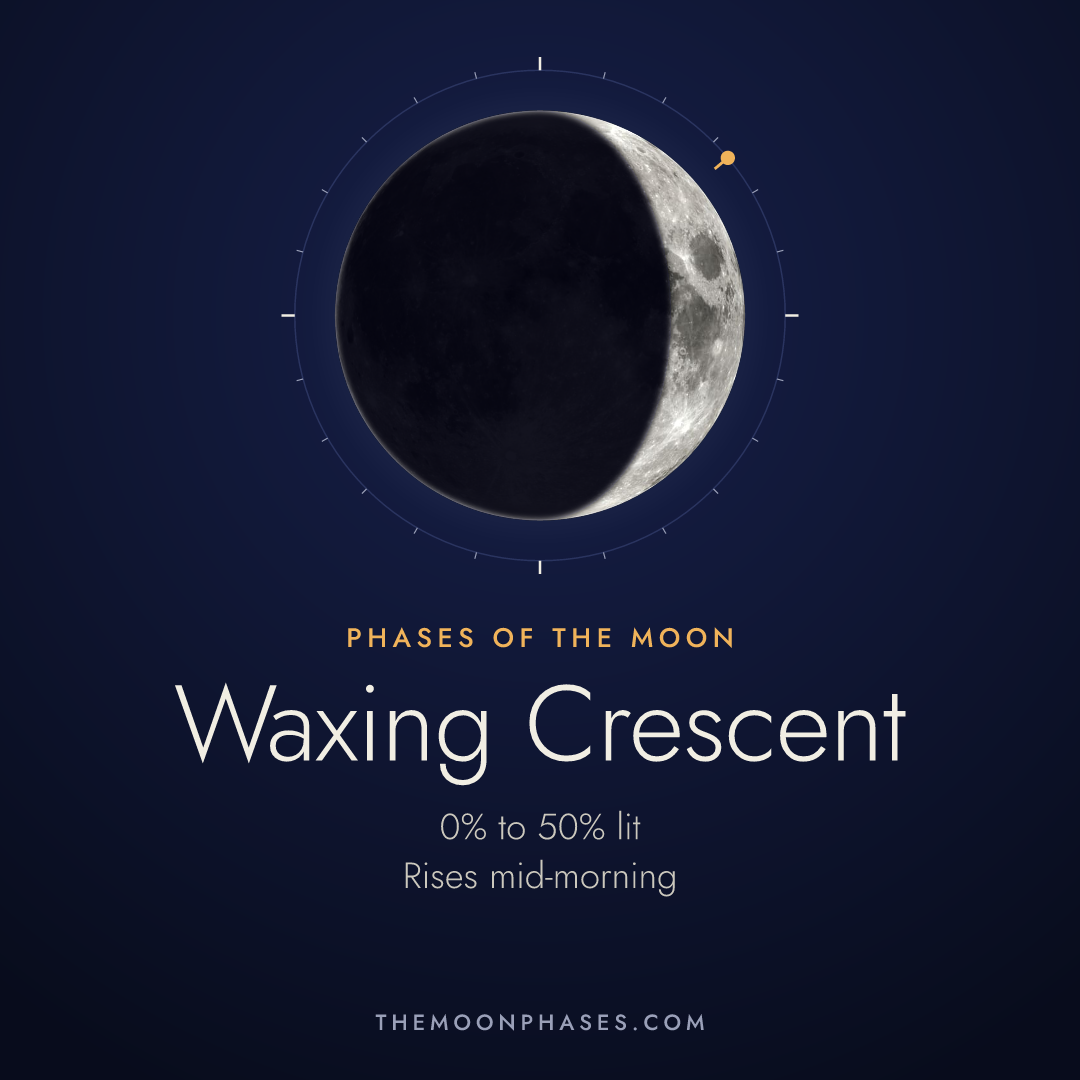
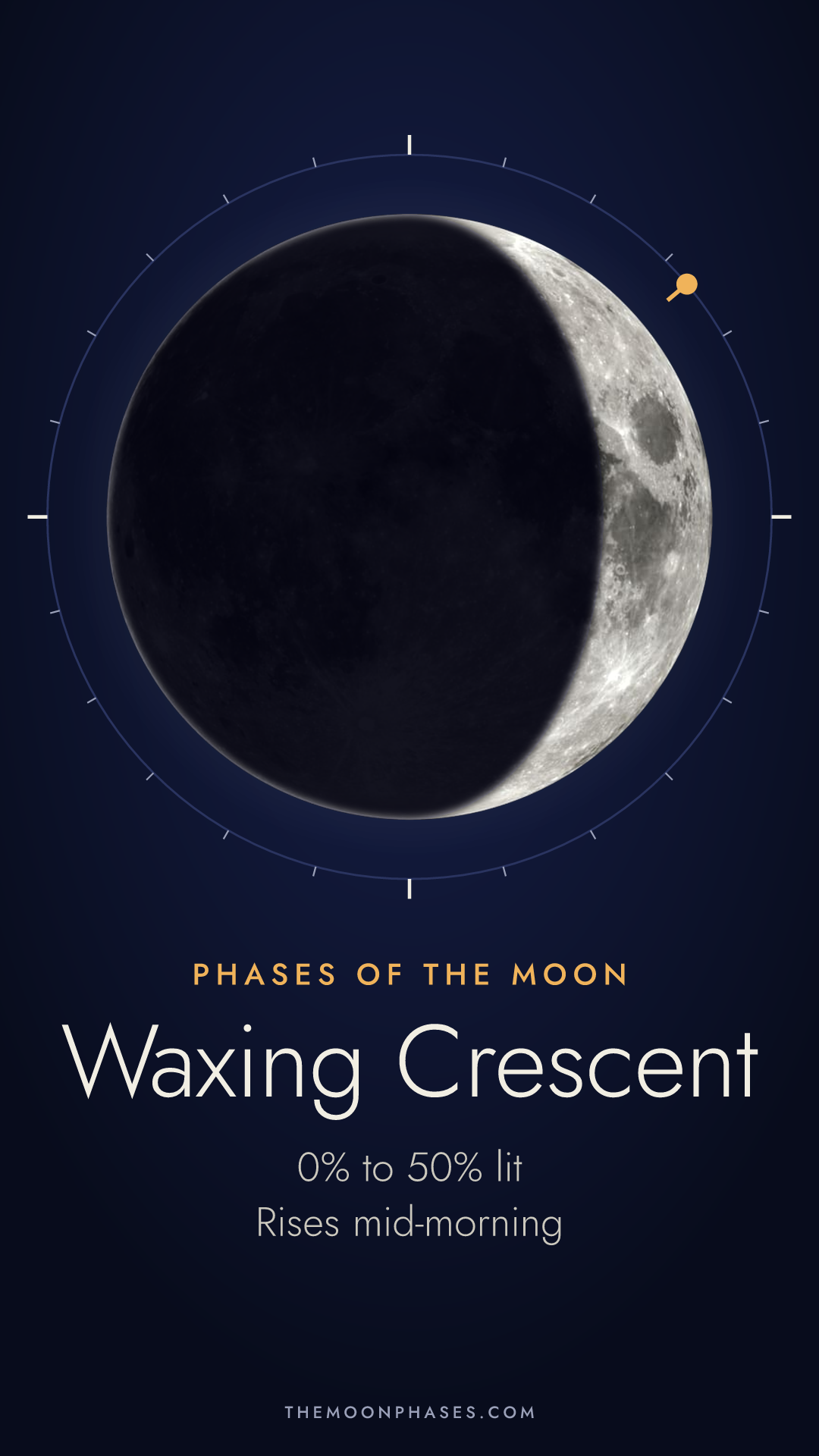
Elongation 0° to 90° · 0% to 50% lit
Waxing Crescent
A growing sliver in the western sky after sunset, lit on the right as seen from the Northern Hemisphere and on the left from the Southern.
- Rises
- Mid-morning
- Highest
- Mid-afternoon
- Sets
- A few hours after sunset
Typical times at mid-latitudes. Best seen: low in the west at dusk. For exact times, pick your city.
What is happening
In the days after new moon the Moon moves east of the Sun, and a thin crescent appears in the evening twilight. Each evening it is higher, thicker, and sets about 50 minutes later.
Look at the dark part of a young crescent and you can often see it glowing faintly. This is earthshine: sunlight reflected from Earth onto the Moon and back to your eye. Leonardo da Vinci explained it correctly around 1510. Earthshine is brightest when the crescent is thin, because a nearly full Earth is then shining in the lunar sky.
The horns of the crescent always point away from the Sun. Near the equator the crescent can lie on its back like a bowl; at high latitudes it stands more upright.
Worth knowing
The line between light and dark is called the terminator. Along it the Sun is rising on the Moon, shadows are long, and craters stand out more sharply than at any other time.