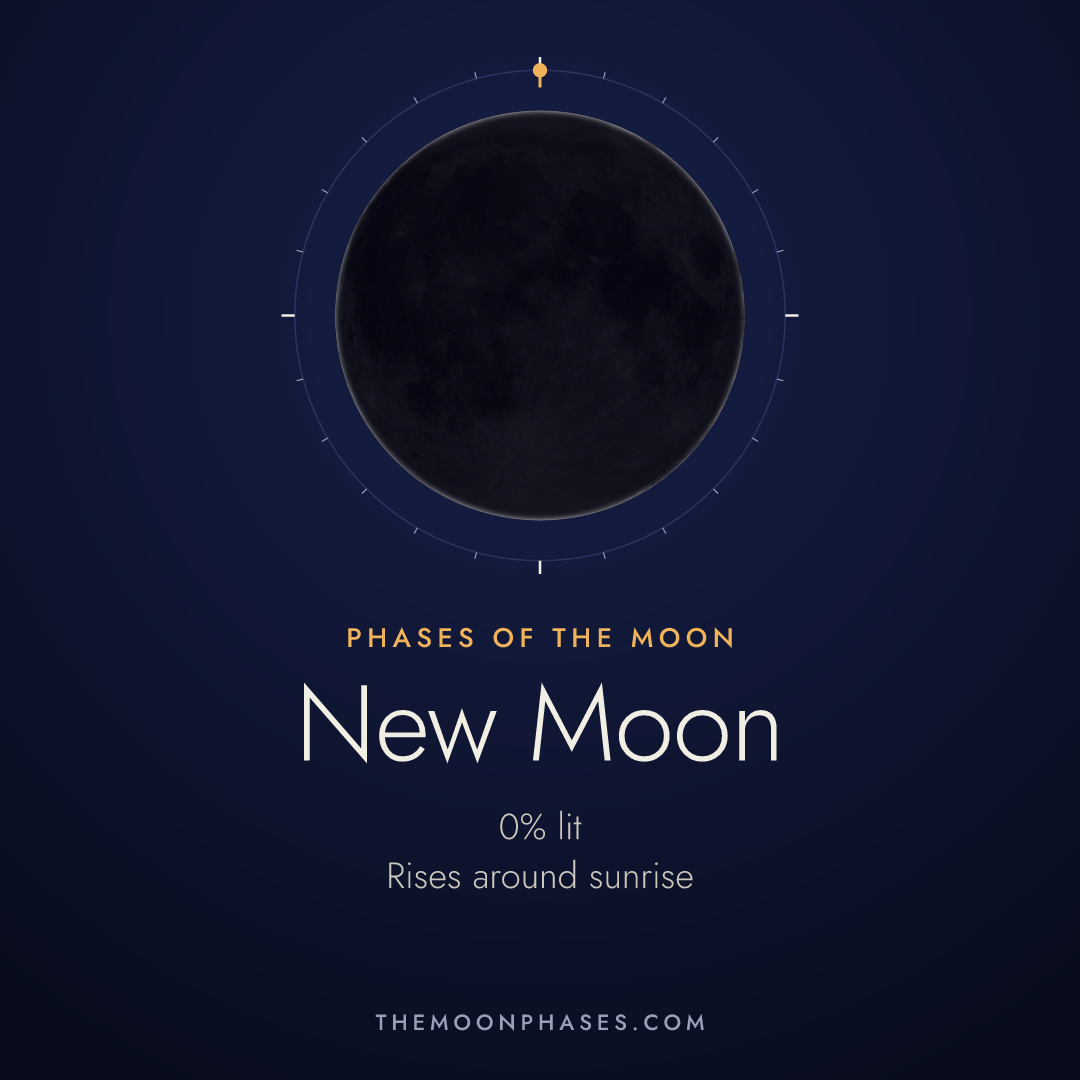
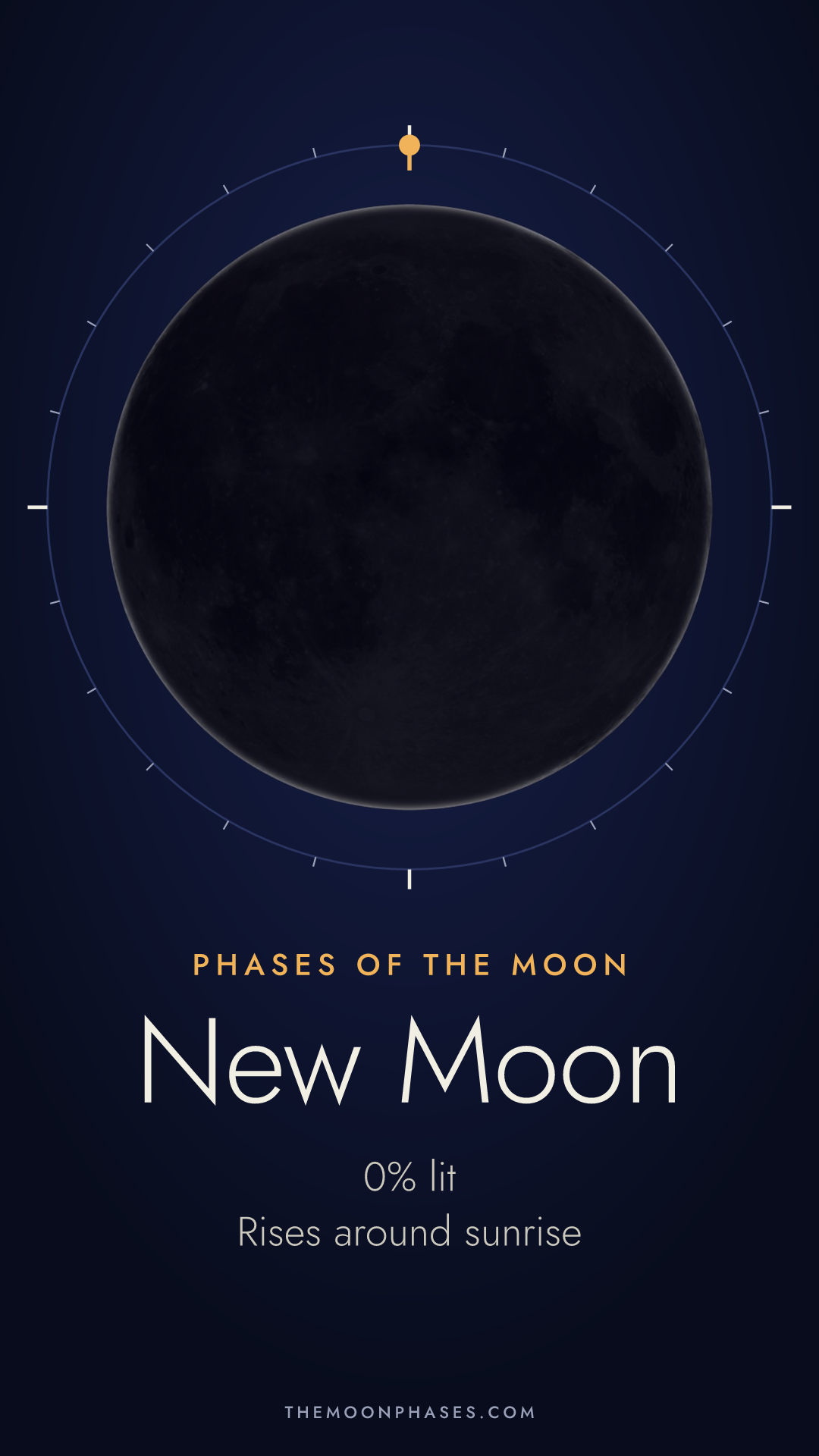
Elongation 0° · 0% lit
New Moon
The Moon sits between Earth and the Sun. Its sunlit side faces away from us and it crosses the sky with the Sun, lost in daylight.
- Rises
- Around sunrise
- Highest
- Around midday
- Sets
- Around sunset
Typical times at mid-latitudes. Best seen: not visible, except in silhouette during a solar eclipse. For exact times, pick your city.
What is happening
New moon is the instant the Moon and Sun share the same ecliptic longitude. Astronomers call this conjunction. The lunar month, or lunation, is counted from one new moon to the next and lasts 29.53 days on average, though individual lunations run from about 29.27 to 29.83 days because both orbits are ellipses.
The Moon usually passes a little above or below the Sun at new moon, because its orbit is tilted about 5.1° to the plane of Earth's orbit. When a new moon falls close to one of the two points where the orbits cross, the Moon covers the Sun and we get a solar eclipse.
Nights around new moon are the darkest of the month, which makes them the best for seeing the Milky Way, faint galaxies and meteor showers.
Worth knowing
Many calendars, including the Islamic, Hebrew and Chinese calendars, begin their months at or just after new moon. The Islamic month traditionally starts with the first sighting of the thin crescent, typically 15 to 24 hours or more after conjunction.