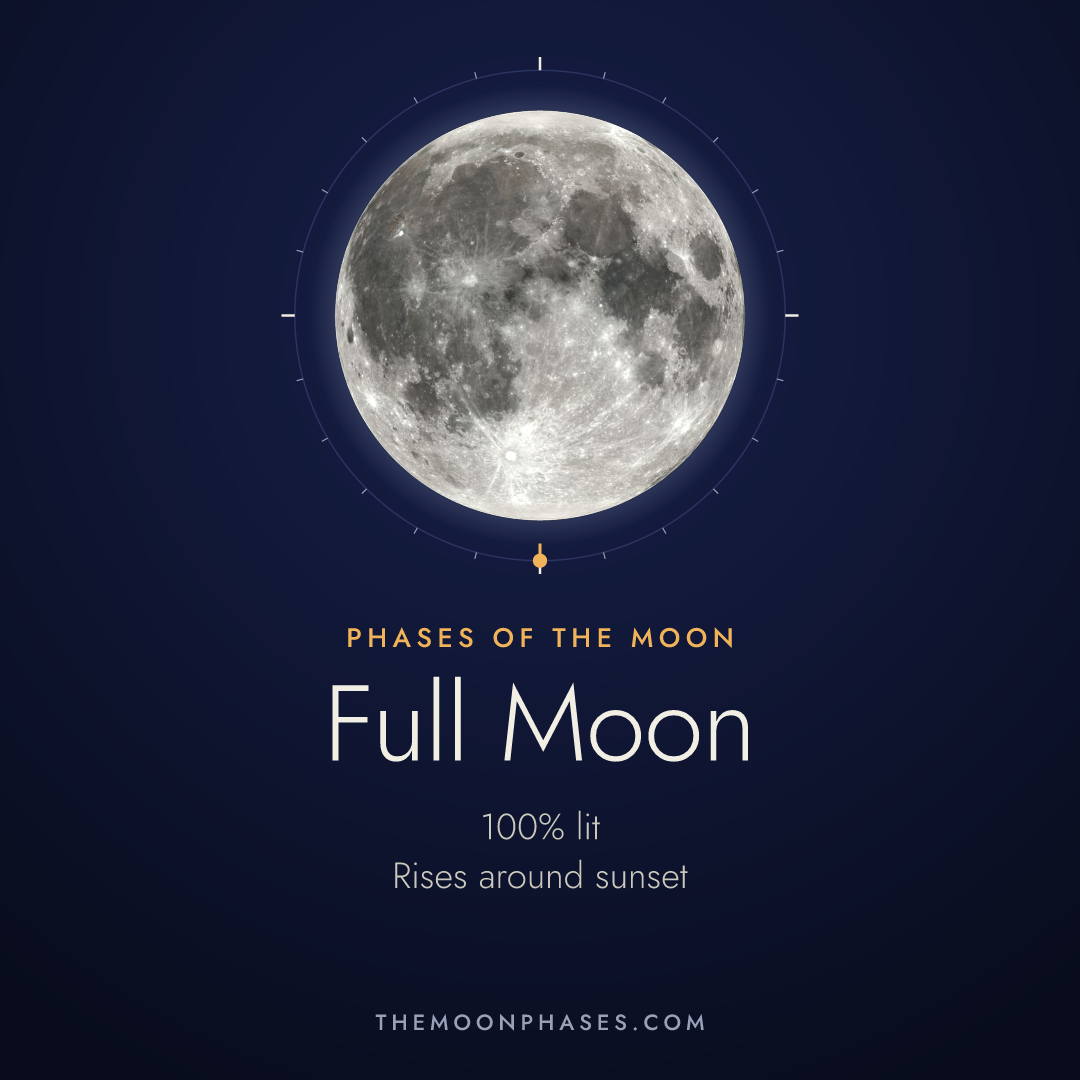
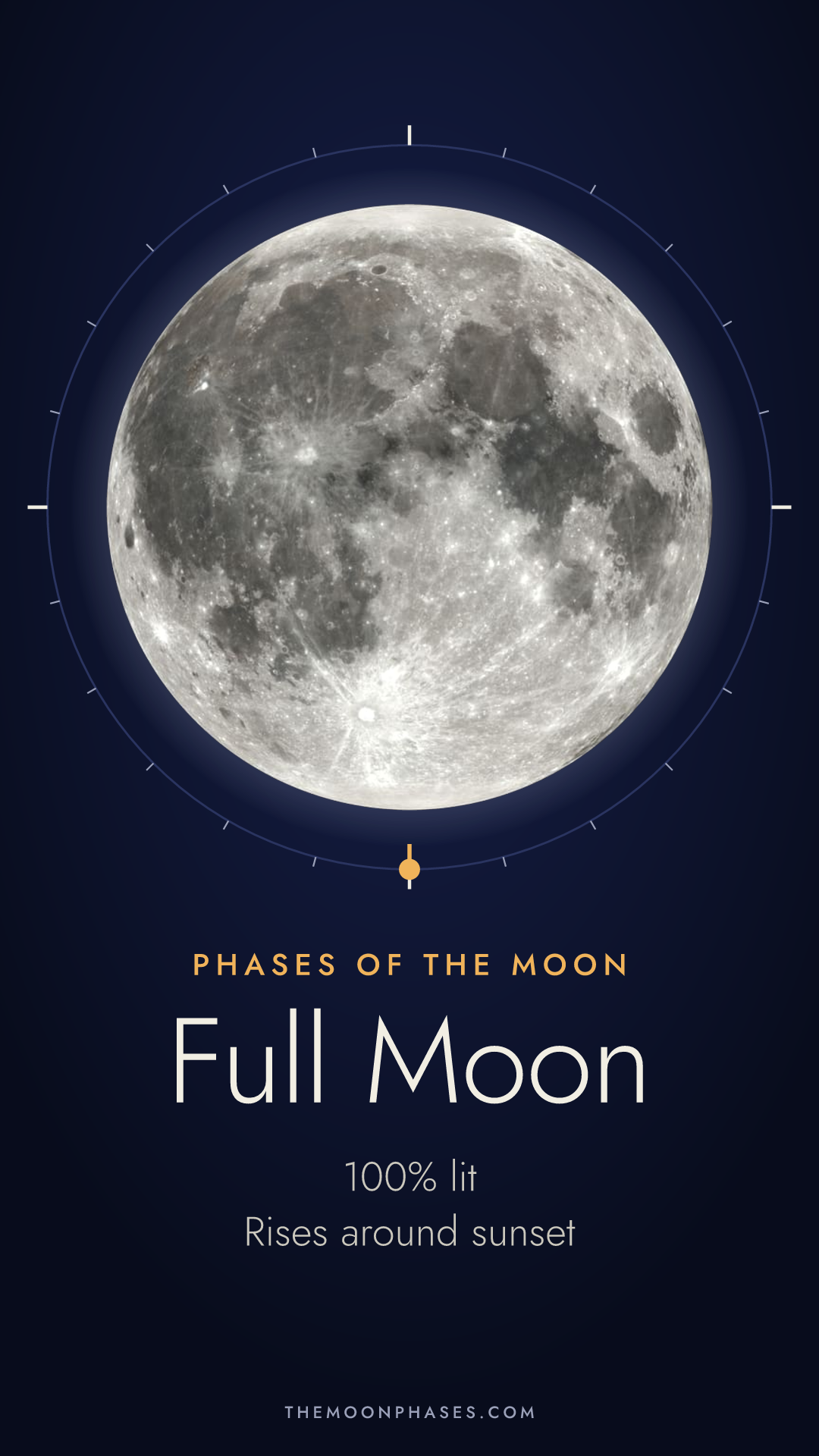
Elongation 180° · 100% lit
Full Moon
The Moon is opposite the Sun and its whole Earth-facing side is lit. It rises around sunset and stays up all night.
- Rises
- Around sunset
- Highest
- Around midnight
- Sets
- Around sunrise
Typical times at mid-latitudes. Best seen: all night. For exact times, pick your city.
What is happening
Full moon is an instant, the moment the Moon is 180° from the Sun in ecliptic longitude. To the eye the Moon looks full for about three days around it.
The Moon is almost never exactly 100% lit. To be perfectly opposite the Sun it would have to pass through Earth's shadow, and then we would see a lunar eclipse. In an ordinary month it passes up to five degrees north or south of the shadow and peaks a fraction of a percent short, between about 99.8% and 99.99%.
A full moon is far brighter than the half moon doubled. Near opposition, shadows on the surface vanish and the soil reflects light back toward its source, an effect called the opposition surge. Each full moon also carries a traditional name.
Worth knowing
The Moon looks bigger near the horizon than overhead. That is the Moon illusion, a trick of perception. Measured with an instrument, the rising Moon is very slightly smaller, because you are about one Earth radius farther from it.