Monday, 26 November 2029
Waning Gibbous
The Moon will be a Waning Gibbous, 75.2% illuminated at midday UTC and20.3 days past new.
- Illumination
- 75.2%79.5% at 00:00, 70.6% at 24:00 UTC
- Moon age
- 20.32 dof a 29.53-day mean cycle
- Distance
- 390,014 km242,343 mi
- Apparent size
- 30.63′arcminutes across
- Constellation
- Cancer
- Elongation
- 239.8°past opposition, waning
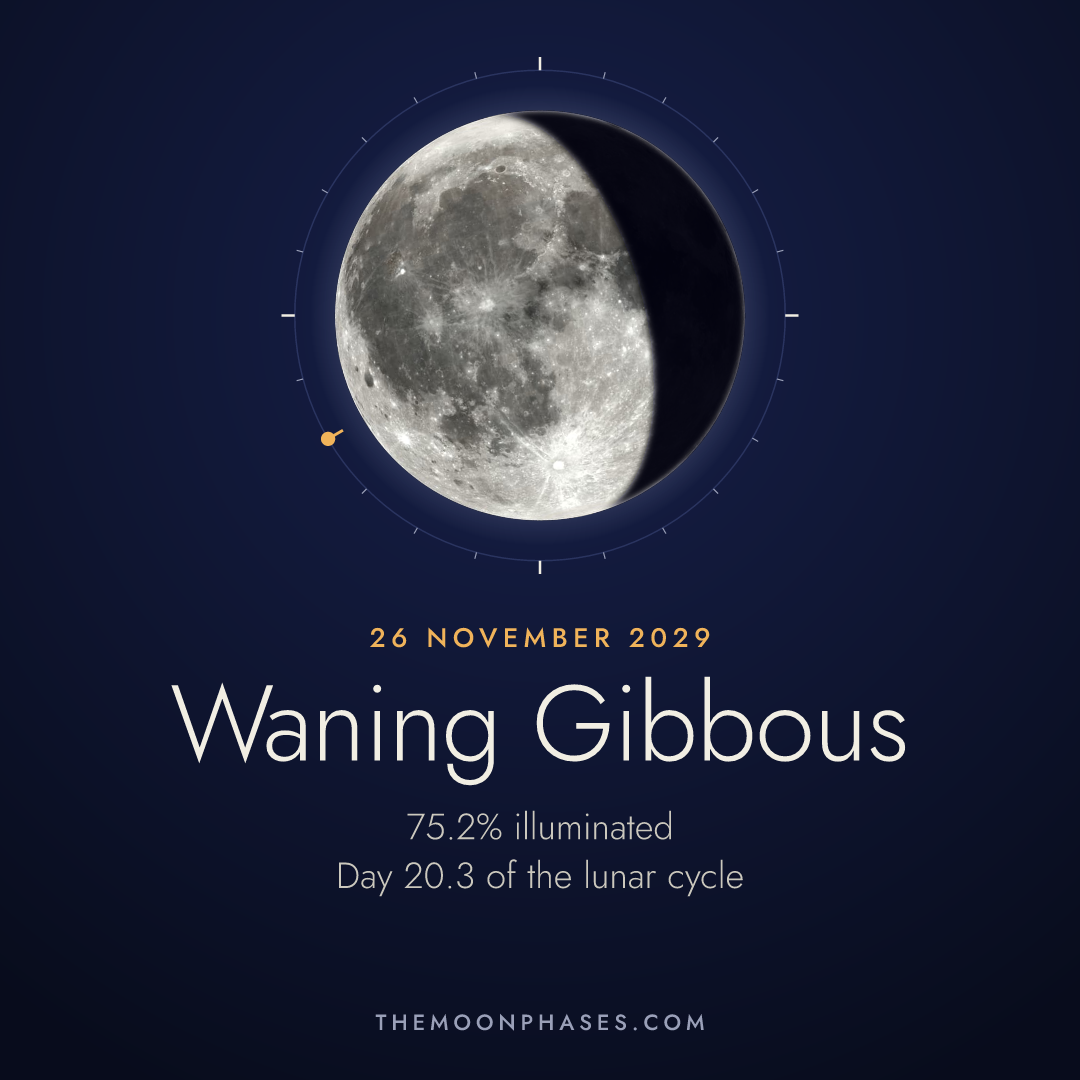
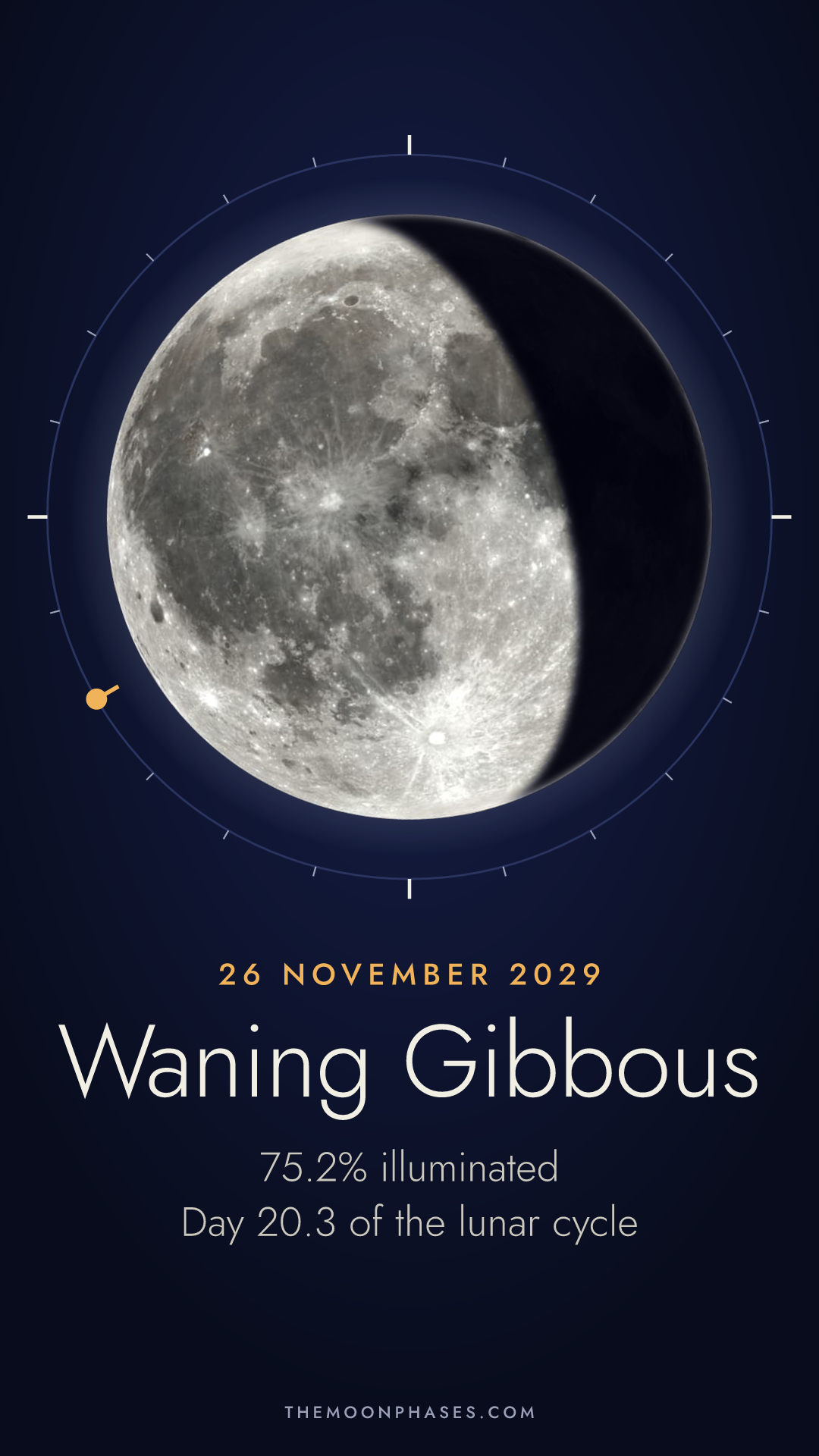
Celestial north is up, as seen from the Northern Hemisphere. From the Southern Hemisphere the same Moon appears rotated half a turn.
Moonrise and moonset on 26 November 2029
| City | Moonrise | Moonset | Highest | Time zone |
|---|---|---|---|---|
| New York | 21:37 | 10:58 | 03:50 at 65° | GMT-5 |
| Los Angeles | 21:53 | 10:47 | 03:53 at 72° | GMT-8 |
| London | 21:03 | 11:23 | 03:44 at 55° | GMT+0 |
| Delhi | 21:56 | 10:46 | 03:55 at 79° | GMT+5:30 |
| Tokyo | 20:54 | 10:12 | 03:06 at 73° | GMT+9 |
| Sydney | 23:41 | 09:38 | 04:19 at 37° | GMT+11 |
Local times. A dash means the event does not happen on that calendar day in that city, which occurs about once a month because the Moon rises roughly 50 minutes later each day. More cities.
Where this day sits in the cycle
This lunation began with the new moon of .
| Last Quarter | |
|---|---|
| New Moon | |
| First Quarter | |
| Full Moon |
For observers
| Right ascension | 8h 23.3m |
|---|---|
| Declination | +15.97° |
| Bright limb position angle | 105.4° |
| Libration in longitude | −6.70° |
| Libration in latitude | +4.24° |
Geocentric apparent coordinates for 12:00 UTC, equator and equinox of date. How we calculate.