Thursday, February 17, 1791
Waxing Gibbous
The Moon was a Waxing Gibbous, 97.7% illuminated at midday UTC and14.3 days past new.
- Illumination
- 97.7%95.8% at 00:00, 99.0% at 24:00 UTC
- Moon age
- 14.25 dof a 29.53-day mean cycle
- Distance
- 380,099 km236,183 mi
- Apparent size
- 31.43′arcminutes across
- Constellation
- Cancer
- Elongation
- 163.1°east of the Sun, waxing
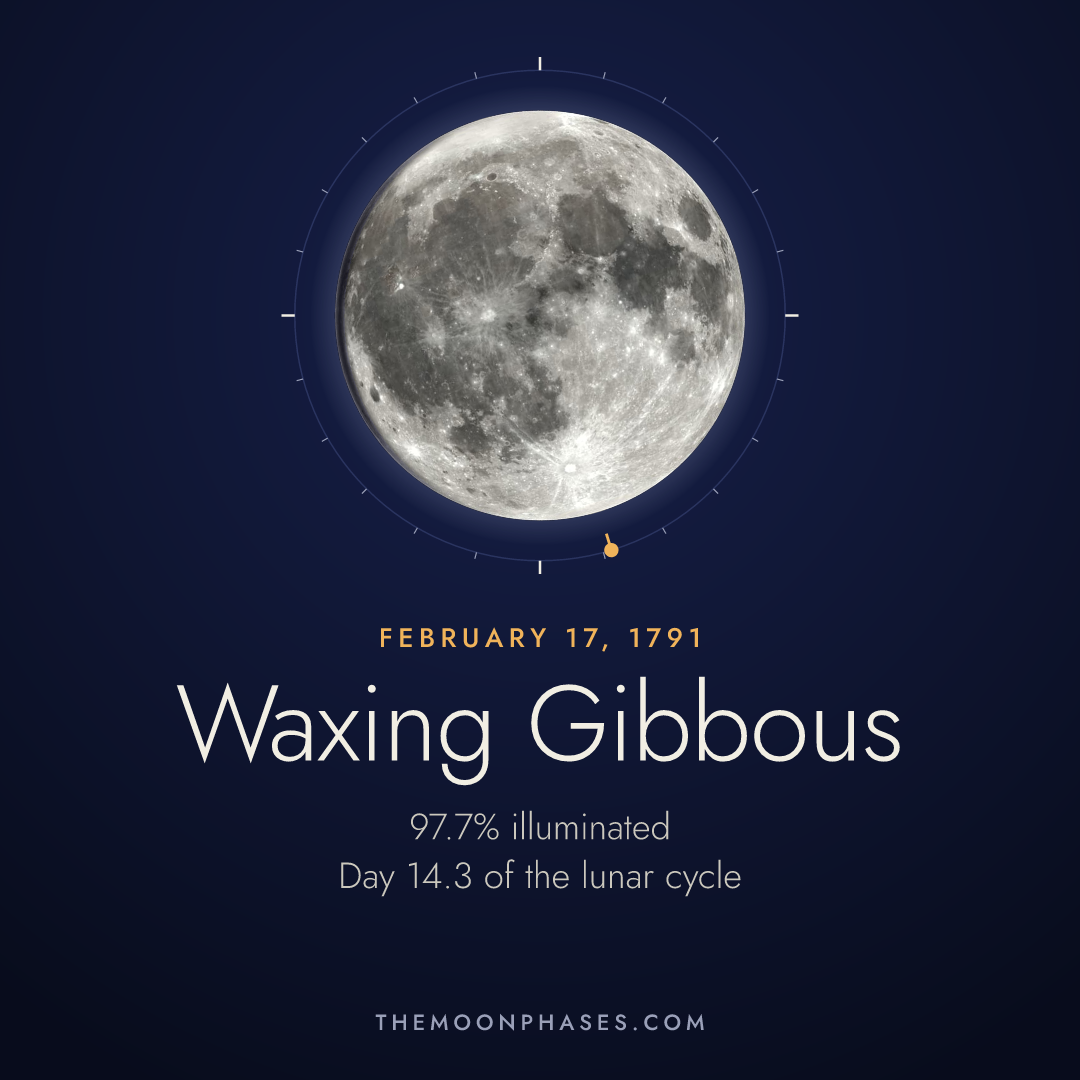
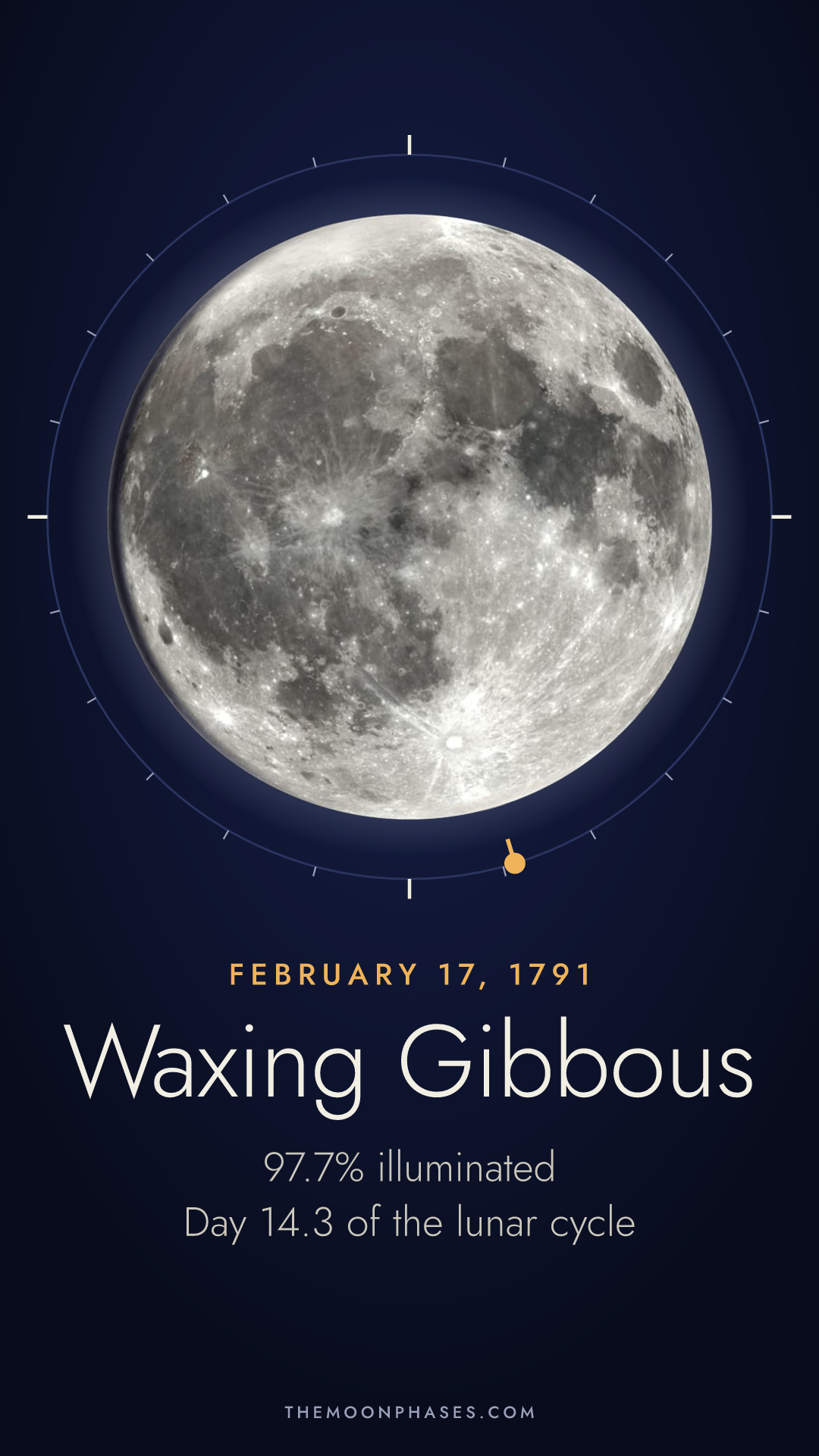
Celestial north is up, as seen from the Northern Hemisphere. From the Southern Hemisphere the same Moon appears rotated half a turn.
Moonrise and moonset on February 17, 1791
| City | Moonrise | Moonset | Highest | Time zone |
|---|---|---|---|---|
| New York | 16:44 | 05:43 | 23:36 at 59° | GMT-4:56:02 |
| Los Angeles | 17:00 | 05:39 | 23:43 at 65° | GMT-7:52:58 |
| London | 16:09 | 05:58 | 23:25 at 49° | GMT-0:01:15 |
| Delhi | 17:18 | 05:53 | 23:59 at 73° | GMT+5:53:28 |
| Tokyo | 16:13 | 05:12 | 23:06 at 66° | GMT+9:18:59 |
| Sydney | 17:29 | 03:42 | 23:04 at 43° | GMT+10:04:52 |
Local times. A dash means the event does not happen on that calendar day in that city, which occurs about once a month because the Moon rises roughly 50 minutes later each day. More cities.
Where this day sits in the cycle
This lunation began with the new moon of .
| Full Moon | |
|---|---|
| Last Quarter | |
| New Moon | |
| First Quarter |
For observers
| Right ascension | 8h 52.1m |
|---|---|
| Declination | +12.59° |
| Bright limb position angle | 270.3° |
| Libration in longitude | −5.42° |
| Libration in latitude | +6.34° |
Geocentric apparent coordinates for 12:00 UTC, equator and equinox of date. How we calculate.