Right now
The centre of the Moon's disc is currently at +3.8° in longitude and −3.3° in latitude. In plain terms, the Moon is turned so that its eastern edge shows a little more than usual, and tipped so we see slightly more of its south. The moon at the top of our home page is drawn with this libration, and you can watch it shift by dragging the time control there.
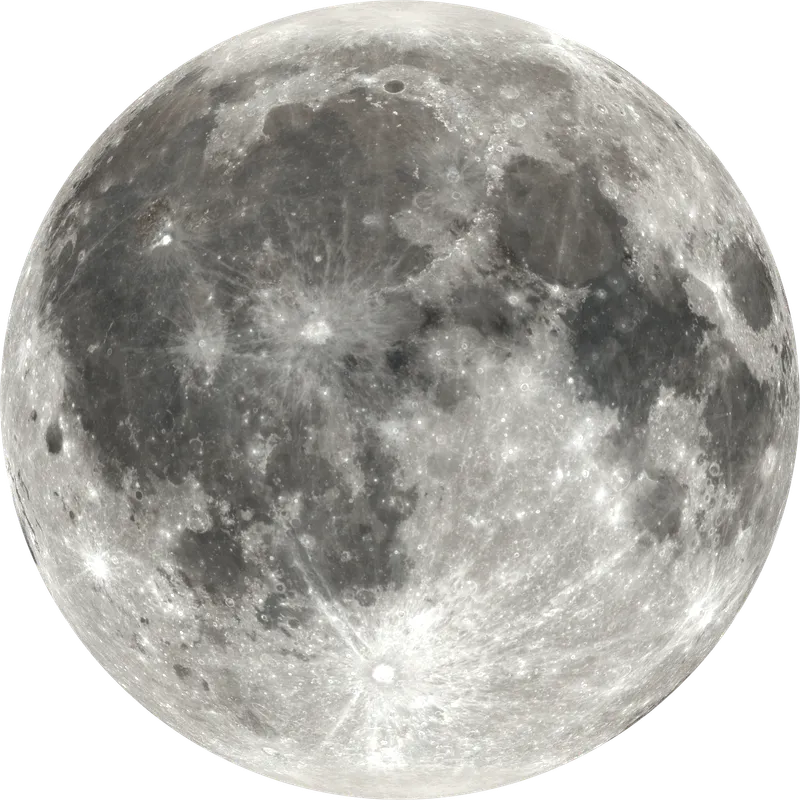
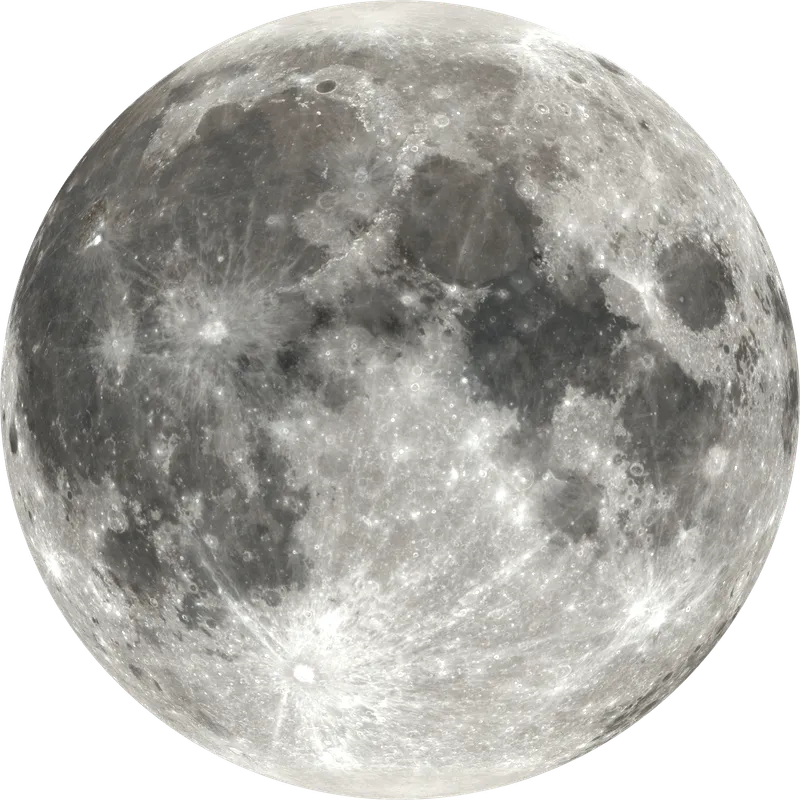
Why it happens
The Moon rotates once for every trip around Earth. If its orbit were a perfect circle lying flat in line with its equator, we would see exactly the same half forever. Neither of those things is true, and each departure gives us a different kind of libration.
Rocking side to side: libration in longitude
The Moon spins at a steady rate, but its orbit is an ellipse, so it travels faster when it is close to Earth and slower when it is far away. Near perigee its orbital motion runs ahead of its rotation; near apogee it falls behind. The result is a slow rocking of up to about 7.9° each way, once per orbit, that brings first the eastern edge and then the western edge into better view.
Nodding up and down: libration in latitude
The Moon's equator is tilted about 6.7° to the plane of its orbit. As the Moon goes around us we look down on its north pole for half the month and up at its south pole for the other half, the same way the Earth's tilt shows each pole to the Sun in turn. This nodding reaches about 6.8° each way.
The view from your side of the planet: diurnal libration
Earth is wide enough to matter. At moonrise you are looking from one side of the planet and at moonset from the other, a shift in viewpoint of up to one Earth diameter. That lets you see about 1° further around the edge that is uppermost at rising and at setting. The figures on this site are computed for the centre of the Earth, so this small extra effect is not included.
A real wobble: physical libration
Everything above is geometry: the Moon is not actually swinging. There is also a genuine oscillation, caused by Earth's gravity tugging on the Moon's slightly uneven shape, but it is tiny, well under a tenth of a degree, and far too small to notice by eye.
What it lets us see
Put the motions together and the centre of the visible disc wanders around an area roughly 16° wide and 14° tall. Over time that exposes about 59% of the lunar surface to observers on Earth. The remaining 41% was never seen by anyone until the Soviet probe Luna 3 photographed the far side in October 1959.
The extra ground is seen at a very shallow angle, squashed against the limb, so libration matters most to observers and photographers chasing features near the edge. Mare Orientale, a vast ringed basin on the western limb, can only be glimpsed at all when libration is strongly in its favour.
The next best dates for each edge
These are the moments in the next 60 days when each edge is turned furthest toward Earth. A favourable libration only helps if that edge is also in sunlight, so check the phase for the date.
How to notice it yourself
- Pick Mare Crisium, the isolated dark oval near the eastern edge (upper right for northern observers). Note how much bright ground separates it from the limb.
- Look again a week or two later. The gap will have changed visibly, even without binoculars.
- For latitude, compare how close the bright crater Tycho, in the south, sits to the bottom edge from one month to the next.
The date pages on this site list the libration in longitude and latitude for any day under For observers, and the data feed includes it too.